How the history of a lunar crater explains the effectiveness of storytelling
How the history of a lunar crater explains the effectiveness of storytelling
Studying the largest impact basin on the Moon using the Chang’e-6 mission is not just an astronomical breakthrough, but a vivid lesson in how complex data is transformed into an understandable story. Understanding how the layers of lunar soil were formed teaches us an important marketing principle: context determines product perception. In a world where audience attention is limited, the ability to build a narrative through the prism of «layers» of experience becomes the primary tool of influence.
What the researchers discovered
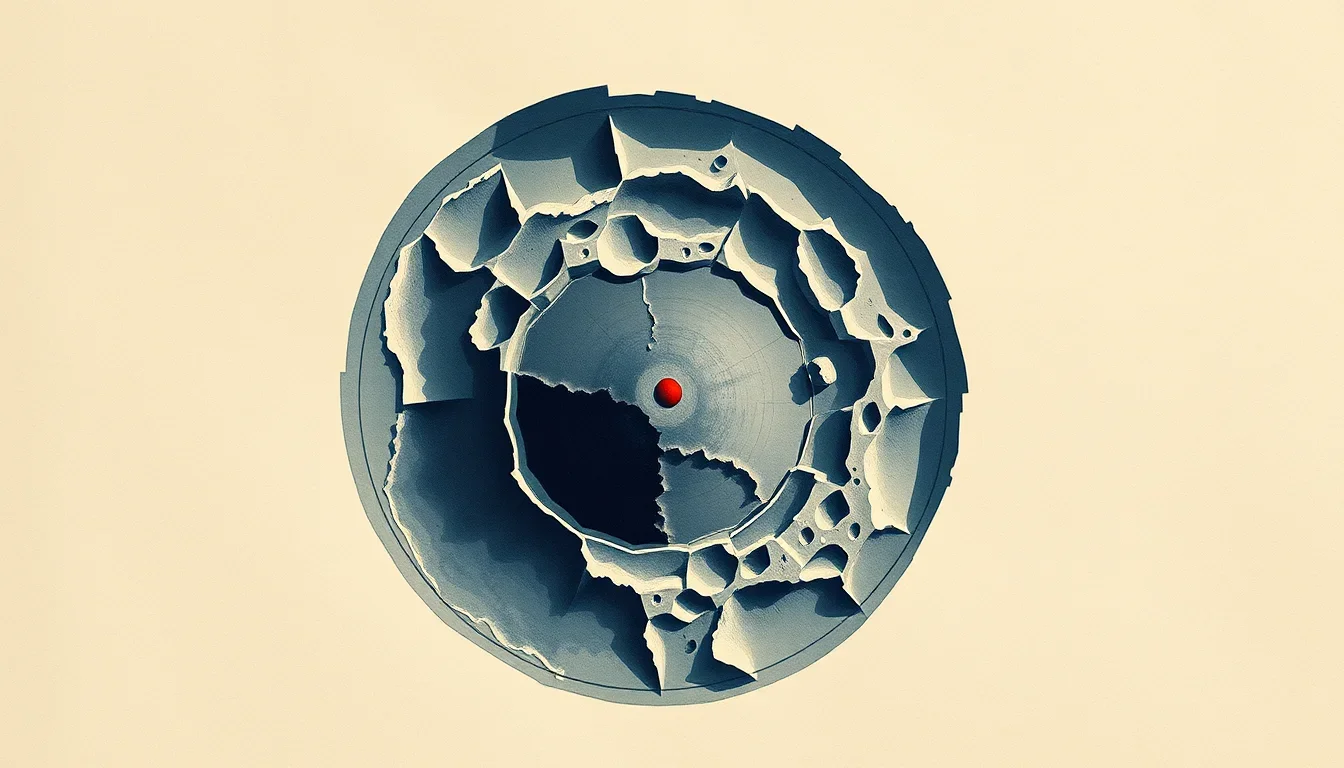
An international group of scientists led by Yuici Qian and Gogun Zhao from the University of Hong Kong published in the journal Science Advances the results of the analysis of 1.9 kg of soil delivered from the far side of the Moon. The researchers studied the mineral composition in the South Pole-Aitken basin, which has colossal dimensions: 2050 by 2400 kilometers.
Stages of surface formation
- First stage (4.34 billion years ago): A powerful impact formed the basin itself and melted the crust rocks.
- Second stage (4.2 billion years ago): The collision that formed the Apollo crater, where the sampling was conducted.
- Third stage (3.87 billion years ago): The formation of the Mare Orientale basin, whose ejecta covered the studied area with a layer of debris.
The analysis showed that 40–50% of the samples are «foreign» materials brought by subsequent impacts. This proves that the lunar surface is a multi-layered «sandwich» from different historical epochs.
How much can we trust this
This is a scientific reconstruction based on a combination of laboratory analyses of physical samples and remote sensing. The researchers used data from the Yutu-2 rover and orbital spacecraft to calibrate their findings.
Although the model looks logical, scientists emphasize that it is one of the most likely versions. To turn it into an indisputable fact, samples from other locations in the basin will be needed, as the current data is limited to the Apollo crater location. In marketing, this is reminiscent of working with data analytics: the more touchpoints (data) we have, the more accurate our strategy will be.
What this means for advertising
The history of the Moon’s formation is the perfect metaphor for brand positioning. A buyer rarely sees a «clean» product; they always perceive it through the prism of previous experience, competitor «ejecta,» and «lava flows» of market trends.
Your offer is not what you created in a vacuum. It is what the client sees on the surface of their past failures and expectations.
If you are selling a complex B2B product, do not expect the client to take it «as is». You need to account for the «layers» of their knowledge and preconceptions to build the right communication.
How to apply this in creative work
Use the «stratigraphy» method in your texts to separate the current advantage from the accumulated baggage:
- Take into account the context (layers): Do not write «we are the best». Write: «We changed the approach that has been the standard since 2020».
- Separate the events: On the landing page, clearly show what is the «foundation» (your core values) and what is the «new impact» (the innovation you offer).
| Presentation type | Example formulation |
|---|---|
| Was (Standard) | Our software speeds up work by 20%. |
| Became (Stratigraphy) | Unlike classic tools that slowed down processes, our service removes extra layers of data, saving you 20% of time. |
Frequently asked questions
Why is it important to know the history of the crater’s formation?
This helps to understand how resources are distributed in the lunar crust. In marketing, this is equivalent to understanding how the pains of your target audience were formed.
How to apply a scientific approach to content analysis?
Separate facts (soil samples) from interpretations (reconstruction of events). In advertising, always rely on hard numbers, and use interpretation to build an emotional connection.
Conclusion
The history of the Moon proves that even the most powerful structures change under the influence of external factors. Your brand is no exception. For your communication to hit the target, you need to understand which «layer» of experience is currently most important for your client. Want to learn how to build persuasive data-driven strategies? Calculate the effectiveness of your current presentation together with RGB Analytics.
Source Naked Science ↗